Best US Business Bank Accounts for Non-Residents in 2026
Opening a US business bank account as a non-resident is possible in 2026, but choosing the right provider can be more complicated than simply registering a US LLC.
A foreign entrepreneur may have a US LLC and EIN but still find that one financial provider accepts the application while another does not. The reason is that providers look at more than the company itself. Your nationality, country of residence, business activity, ownership structure, expected transaction volume, source of funds, customer locations and the type of payments you expect to receive can all affect onboarding.
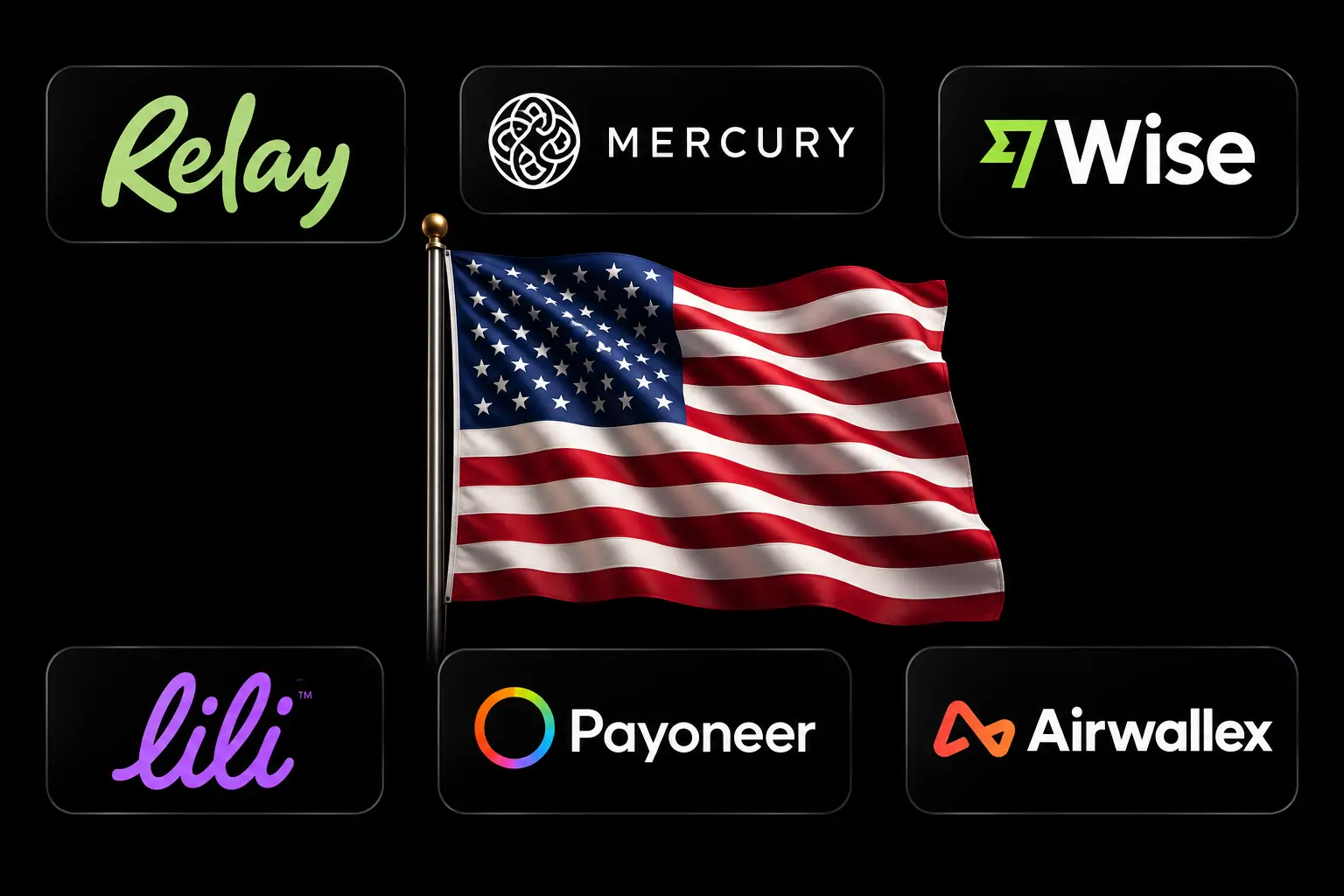
For international founders, several online providers are commonly considered, including Mercury, Relay, Wise, Lili, Payoneer and Airwallex. However, they are not identical products. Some are designed primarily around US business banking, while others are particularly useful for international payments, marketplace payouts or multi-currency transactions.
This guide explains the main differences so you can determine which type of US business account for non-residents may fit your business.
Important: Eligibility and product availability can change by country and business activity. Approval is never guaranteed. Always check the provider’s current requirements before applying.
Quick Comparison: US Business Accounts for Non-Residents
| Provider | Best suited for | Non-US founders | Multi-currency | US LLC commonly required? |
|---|---|---|---|---|
| Mercury | Startups, SaaS, agencies and US-focused businesses | Yes | Limited compared with global platforms | Yes |
| Relay | Small businesses wanting separated accounts and expense management | Yes, subject to eligibility | Primarily USD banking | Yes |
| Wise Business | International payments and receiving money in multiple currencies | Depends on country/business eligibility | Yes | Not always |
| Lili | Small businesses and international founders from supported countries | Yes | International payment support | Yes |
| Payoneer | Freelancers, marketplaces and international client payments | Yes | Yes | Not always |
| Airwallex | Global businesses with international operations | Depends on supported market | Yes | Depends on account/product |
The most appropriate option depends on your nationality, residence, business activity, expected transaction volume and other onboarding considerations.
Can a Non-Resident Open a US Business Bank Account?
Yes, in maximum cases.
You do not necessarily need to be a US citizen or US resident to obtain financial services for a US business.
For example, Mercury states that international founders can apply without being US citizens or residents. The business must be formed in the United States or a US territory, have existing or planned US operations, and provide an acceptable principal business address.
Other providers have different requirements.
A typical application may require:
- US LLC formation documents
- EIN
- Passport or government-issued identification
- Proof of residential address
- Business website
- Description of business activities
- Information about customers and suppliers
- Expected transaction volume
- Ownership information
- Source-of-funds information
- Details about where the business operates
Depending on the provider and your circumstances, additional documentation may be requested during KYC and KYB review.
This is why having a US LLC and EIN does not automatically guarantee approval.
Best US Business Bank Accounts for Non-Residents in 2026
1. Mercury
Best for: US startups, SaaS businesses, agencies, e-commerce companies and technology businesses.
Mercury is one of the better-known online business banking platforms used by international founders with US companies.
Mercury specifically states that a founder does not need to be a US citizen or resident to apply. However, the company must be registered in the US or a US territory and must have existing or planned operations in the United States. Mercury also requires an acceptable principal place of business address and does not accept a registered-agent address, PO box or UPS Store address for that purpose.
Why international founders consider Mercury
Mercury can be attractive for businesses that need more than basic payment collection.
Depending on eligibility and the products available to the business, features can include:
- US business checking
- Savings
- ACH transfers
- Domestic and international wires
- Debit cards
- Expense management
- Team permissions
- Integrations
- API capabilities
Mercury says its banking services are provided through FDIC-insured banking partners, including Choice Financial Group and Column N.A., with a sweep network that can provide up to $5 million in FDIC insurance for eligible deposits.
Things to consider
Mercury is not available to every founder worldwide. The company maintains restrictions covering certain countries and regions.
Your business activity also matters.
A US LLC alone is not enough to assume approval.
Mercury may be worth considering if: you operate a genuine US business, have a clear business model and need a more traditional business-banking experience.
2. Relay
Best for: Small businesses that want to organize operating expenses, taxes and profit separately.
Relay is another online business banking option that international founders may consider.
Its account structure can be particularly useful for businesses that want to separate money for different purposes instead of keeping everything in one checking account.
For example, a business could potentially maintain separate balances for:
- Operating expenses
- Taxes
- Payroll
- Profit
- Contractor payments
Relay’s eligibility requirements still matter. International applicants must meet its current country and business requirements, and businesses may need a qualifying US operating presence and physical US address.
Why Relay can be useful
For a growing business, separating money can make financial management easier.
Instead of looking at one account balance and trying to remember how much belongs to the tax reserve or upcoming expenses, dedicated accounts can provide a clearer picture.
Relay can therefore be interesting for:
- Agencies
- Consultants
- E-commerce businesses
- Service companies
- Small online businesses
Things to consider
Relay’s eligibility rules and country restrictions should be checked before applying.
A registered-agent address should not automatically be assumed to satisfy an operating-address requirement.
Relay may be worth considering if: your priority is organizing business finances rather than simply receiving international payments.
3. Wise Business
Best for: International businesses that receive and send money in multiple currencies.
Wise Business is somewhat different from a conventional US business bank account.
Its major strength is international money movement.
Wise states that Wise Business supports different types of businesses, including freelancers, entrepreneurs, limited companies and other business structures, subject to country and business eligibility.
The exact features available depend on where you live and where your business is registered.
Wise’s availability checker shows that features vary by country, which is particularly important for non-resident founders.
Why international businesses use Wise
A company working with clients in different countries may need to receive payments in currencies such as:
- USD
- GBP
- EUR
- CAD
- AUD
- SGD
Instead of constantly converting money through traditional banks, a multi-currency platform can make international transactions easier to manage.
Wise can therefore be particularly relevant for:
- International consultants
- Remote agencies
- Freelancers
- SaaS businesses
- Global service providers
- Companies with overseas customers
Important limitation
Wise should not automatically be treated as a replacement for every US business banking requirement.
Its availability and account features depend on the customer’s country and business circumstances.
Wise may be worth considering if: your business receives or sends significant international payments and multi-currency functionality is more important than traditional US banking features.
4. Lili
Best for: Small businesses and international entrepreneurs from supported countries.
Lili has become another option for non-US citizens operating US-registered businesses.
Lili states that non-US citizens living outside the United States can apply if they have a US-registered business and citizenship from one of Lili’s supported countries.
Its current published supported-country list includes countries such as India, China, Australia, Canada, the United Kingdom and United Arab Emirates, among others. The list can change, so applicants should verify eligibility before applying.
What Lili offers
Depending on eligibility and plan, business features can include:
- Business checking
- Debit card
- ACH functionality
- International wires
- Expense management
- Savings features
- Business financial tools
Lili says international businesses can receive international wires in multiple currencies, with funds converted to USD before reaching the account.
What non-residents should know
Lili’s requirements differ from Mercury and other providers.
For international applicants, Lili may accept a passport number instead of an SSN, subject to its requirements.
The business must be properly registered in the United States.
Lili may be worth considering if: you are an international founder from a supported country and operate a relatively straightforward US business.
5. Payoneer
Best for: Freelancers, international service providers, marketplace sellers and businesses receiving cross-border payments.
Payoneer is different from a conventional US business checking account.
Its main appeal is helping businesses and independent professionals receive payments from international customers and platforms.
For example, a business may use Payoneer for:
- International client payments
- Marketplace payouts
- Cross-border payments
- Contractor and supplier payments
- Receiving funds in supported currencies
This can make it useful for businesses whose main requirement is international payment collection rather than a complete US banking relationship.
Payoneer vs a US business bank account
This distinction is important.
If your business needs a full operating account for:
- Payroll
- Business expenses
- ACH payments
- Vendor payments
- US banking relationships
- Multiple employees
- Detailed business financial management
you should compare Payoneer’s functionality with dedicated business banking providers.
Payoneer may be worth considering if: your primary need is receiving international or marketplace payments.
6. Airwallex
Best for: International companies with multiple currencies, overseas customers and global operations.
Airwallex focuses heavily on international business.
Its Business Account product is designed to help companies manage multiple currencies, international transfers and corporate spending.
Airwallex states that its global business accounts can provide local collection capabilities in multiple markets, foreign-exchange services, international transfers and multi-currency corporate cards.
The platform also supports integrations with services such as Xero, Amazon and Shopify.
Why Airwallex can be interesting for international businesses
Suppose a US company has:
- Customers in the United States
- Contractors in India
- Suppliers in China
- Advertising expenses in Europe
- Revenue in USD, GBP and EUR
A global financial platform can potentially simplify this type of setup.
Airwallex publishes supported regions and currencies, but availability differs according to the customer’s location, account type and regulatory structure.
Airwallex may be worth considering if: your business is genuinely international and requires multi-currency collections, FX and global expense management.
Mercury vs Relay vs Wise vs Lili vs Payoneer vs Airwallex
There is no single account that is appropriate for every non-resident business.
The right choice depends heavily on what you actually need.
| Requirement | Mercury | Relay | Wise | Lili | Payoneer | Airwallex |
|---|---|---|---|---|---|---|
| US LLC banking | ✓ | ✓ | Depends | ✓ | Not primarily | Depends |
| International founders | ✓ | ✓ subject to eligibility | ✓ subject to country | ✓ subject to supported country | ✓ | ✓ subject to market |
| Multi-currency focus | Moderate | Lower | Strong | Moderate | Strong | Strong |
| International payments | ✓ | ✓ | ✓ | ✓ | ✓ | ✓ |
| Business expense management | ✓ | ✓ | Limited compared with banking platforms | ✓ | ✓ | ✓ |
| Marketplace payments | Possible | Possible | Possible | Possible | Strong use case | Strong |
| Global operations | ✓ | Moderate | Strong | Moderate | Strong | Strong |
| Best suited to | US businesses | Small businesses | International payments | Small businesses | Cross-border payments | Global businesses |
Note: A checkmark does not mean guaranteed availability or approval. Product availability, supported countries and features can vary.
Which US Business Account Is Right for a Non-Resident?
Instead of asking “Which is the best US bank account?”, it is usually more useful to ask:
“Which provider is most compatible with my business?”
Here are some practical scenarios.
If you run a US SaaS company
Mercury may be worth investigating because it supports international founders and is designed around US businesses, startups and technology companies.
If you run a small agency
Compare Mercury, Relay and Lili based on your country of residence, business structure and transaction requirements.
If you mainly receive international payments
Wise, Payoneer and Airwallex may be particularly relevant because international payment functionality is central to their offerings.
If you operate across several countries
Airwallex and Wise may deserve closer consideration because of their multi-currency and international payment capabilities.
If you are an Indian entrepreneur with a US LLC
Do not assume that every provider will treat Indian applicants identically.
Lili currently publishes India among its supported citizenship countries, while Mercury’s eligibility depends on its current country restrictions and business requirements.
Your specific business activity and documentation still matter.
What Documents Do Non-Residents Usually Need?
Although requirements vary, you should generally be prepared with the following documents.
1. US LLC formation documents
This can include:
- Articles of Organization
- Certificate of Formation
- Operating Agreement
2. EIN
The Employer Identification Number issued by the IRS is commonly required for US business financial services.
3. Passport
International founders will generally need valid government-issued identification.
4. Proof of residential address
Depending on the provider, this may include a utility bill, bank statement or other acceptable document.
5. Business website
A professional website can help explain what your business actually does.
6. Business description
You should be able to clearly explain:
- What you sell
- Who your customers are
- Where your customers are located
- How you acquire customers
- Where suppliers are located
- How the company makes money
7. Expected transaction activity
You may be asked about:
- Expected monthly revenue
- Average transaction size
- Number of transactions
- Incoming payments
- Outgoing payments
- International transfers
Providing realistic information is important.
Why US Business Account Applications Get Rejected
Having a US LLC does not automatically make a business eligible for every financial provider.
Applications can require additional review because of:
Country restrictions
Some providers cannot onboard customers from certain countries or regions.
Business activity
Certain industries carry additional compliance requirements or may not be supported.
Address problems
A registered-agent address may not satisfy a provider’s requirement for a principal or operating business address.
For example, Mercury explicitly says registered-agent addresses, PO boxes and UPS Store addresses are not acceptable as the principal place of business address.
Inconsistent information
Your company formation documents, website, application and transaction explanation should tell the same story.
Unclear source of funds
Providers may request information about where business funds originate.
Unexpected transaction volumes
If you state that your business expects $10,000 per month and suddenly receives $500,000 without a reasonable explanation, additional review may occur.
Can You Open a US Business Bank Account Without Visiting the USA?
In some cases, yes.
Several fintech and financial platforms offer remote applications for eligible international founders.
Mercury explicitly says founders do not need to be physically located in the United States to apply, provided the business and application meet its requirements.
Lili also states that non-US citizens living outside the United States can apply if they meet its international eligibility requirements and own a qualifying US-registered business.
However, remote application does not mean guaranteed approval.
The provider still has to complete its KYC/KYB and compliance review.
Do You Need an SSN or ITIN?
Not necessarily.
A non-resident entrepreneur does not automatically need a US Social Security Number simply because they own a US LLC.
However, the identification requirements vary between providers and applicant types.
Some providers may accept a foreign passport and EIN for eligible international founders, while others may require additional information.
For example, Lili states that certain non-US residents can apply using a passport number instead of an SSN, subject to its requirements.
Always check the current provider requirements before submitting an application.
What About Traditional US Banks?
Non-resident entrepreneurs sometimes assume that the easiest route is to open an account with a major traditional US bank.
That can be more complicated than using an online provider.
Traditional banks may have additional requirements around:
- Physical presence
- Identification
- US address
- SSN or tax identification
- Business documentation
- Branch visits
- Relationship history
For a founder living outside the United States, online financial providers can therefore be worth researching first.
That does not mean a traditional bank account is impossible. It simply means the onboarding process can be different.
How to Improve Your Chances of Approval
There is no legitimate way to guarantee approval.
However, you can make your application clearer and easier to review.
1. Use accurate company information
Make sure your legal name, EIN, formation documents and ownership information match.
2. Have a professional website
Your website should clearly explain what the company sells.
3. Explain your business model
Avoid vague descriptions such as:
“Online business.”
Instead, explain what you sell, who buys it and how you receive revenue.
4. Prepare your source-of-funds information
Be ready to explain where the company’s initial and future funds will come from.
5. Estimate transaction volume realistically
Do not artificially lower or inflate your expected volume.
6. Choose a provider based on your actual requirements
A freelancer receiving $5,000 monthly from overseas clients has very different requirements from an e-commerce company processing $300,000 per month.
7. Do not submit multiple applications blindly
If one provider declines your application, understand the reason where possible and reassess which provider matches your situation.
US Business Bank Account for Non-Residents: What Should You Choose?
The answer depends on your business.
Mercury can be relevant for US-focused startups, SaaS companies, agencies and other businesses that meet its international-founder requirements.
Relay can be useful for businesses that want structured account management and separation of operating funds.
Wise Business can be attractive for international businesses that prioritize multi-currency payments.
Lili is another option for eligible international founders from supported countries operating US-registered businesses.
Payoneer can be particularly relevant for marketplace sellers, freelancers and companies whose primary requirement is international payment collection.
Airwallex can be attractive for businesses with substantial international operations and multi-currency requirements.
The most appropriate option will depend on your nationality, residence, business activity, expected transaction volume, ownership structure, customer locations and the provider’s current onboarding rules.
Need Help Opening a US Business Account as a Non-Resident?
If you are planning to form a US LLC from outside the United States, choosing the financial provider should be part of the planning process—not something you think about after the company has already been formed.
At Activate Global Limited, we help international entrepreneurs with US business setup and can provide guidance on the documentation and application process for eligible financial providers.
Our team can help you understand:
- US LLC formation requirements
- EIN requirements
- Business address requirements
- Financial-provider eligibility
- KYC/KYB documentation
- Business account application preparation
- International payment requirements
Because each provider has its own onboarding criteria, we do not treat bank-account approval as automatic or guaranteed.
The objective is to match your business profile with a provider whose requirements you are more likely to meet.
If you are a non-resident planning to establish a US company, you can contact Activate Global Limited to discuss your business structure and banking requirements.
Frequently Asked Questions
1. Can a non-resident open a US business bank account?
Yes. Eligible non-residents can apply for certain US business banking and fintech accounts without being US citizens or residents. Requirements vary by provider, country of residence, business activity and company structure.
2. What is the best US business bank account for non-residents in 2026?
There is no single account that suits every non-resident business. Mercury, Relay, Wise, Lili, Payoneer and Airwallex have different eligibility requirements, features and international payment capabilities.
3. Can I open a US business bank account without visiting the USA?
In many cases, yes. Some providers allow eligible international founders to complete the application remotely. However, additional identity, business and compliance verification may be required.
4. Can I open a US business bank account from India?
Potentially, yes. Indian entrepreneurs with eligible US businesses can apply to providers that support their country and business profile. Approval depends on the provider’s current onboarding requirements.
5. Can I open a US business bank account without an SSN?
Some providers accept eligible non-US founders without a Social Security Number. Depending on the provider, you may need documents such as a passport, EIN and US company formation documents.
6. Do I need a US LLC to open a US business bank account as a foreigner?
Many US-focused business banking providers require a US-registered business, such as an LLC or corporation. However, international payment platforms may have different requirements.
7. Can a foreign-owned US LLC get a business bank account?
Yes, an eligible foreign-owned US LLC can apply for business banking services. The provider may review the company’s ownership, business activity, location, expected transactions and supporting documentation.
8. What documents does a non-resident need to open a US business bank account?
Commonly requested documents include a passport, US LLC formation documents, EIN, proof of residential address, business website and information about the company’s activities, customers, expected transactions and source of funds.
9. Can I use a registered agent address to open a US business bank account?
Not necessarily. Some providers require a principal or operating business address and may not accept a registered-agent address for this purpose. Always check the specific provider’s address requirements.
10. Which US business account is best for international payments?
The answer depends on your payment requirements. Wise, Payoneer and Airwallex are particularly focused on international and multi-currency payments, while providers such as Mercury and Relay offer broader US business-account functionality.
11. What is the difference between Mercury, Relay, Wise, Lili, Payoneer and Airwallex?
These providers serve different purposes. Mercury and Relay focus more heavily on US business banking, Wise and Payoneer are widely used for international payments, Lili provides business banking for eligible businesses, and Airwallex focuses strongly on global business payments and multi-currency operations.
12. Can a non-resident receive USD payments from US customers?
Yes, depending on the provider and account type. Eligible accounts may support payment methods such as ACH or wire transfers, although available receiving capabilities vary between providers.
13. Can I receive payments from Stripe, PayPal, Amazon or other platforms into my US business account?
Potentially. Whether a particular platform can be connected depends on the platform’s own eligibility rules, your business details and the financial account’s supported payment methods. Having a US LLC does not automatically qualify a business for every payment platform.
14. Why was my US business bank account application rejected?
Applications can be declined or require additional review for various reasons, including country restrictions, unsupported business activities, address issues, incomplete documentation, ownership concerns or information that does not satisfy the provider’s compliance requirements.
15. How can I choose the right US business bank account as a non-resident?
Start by comparing your nationality, country of residence, business activity, company structure, expected transaction volume, customer locations, currencies and payment requirements against each provider’s current eligibility criteria. The most appropriate option will depend on your individual business profile.
16. How can Activate Global Limited help non-residents choose the right US business bank account?
Activate Global Limited helps non-resident entrepreneurs compare suitable US business banking options based on their nationality, country of residence, business activity, US company structure, expected transaction volume, payment requirements and other onboarding considerations. Instead of recommending the same provider to every client, we help identify which available options—such as Mercury, Relay, Wise, Lili, Payoneer or Airwallex—may be more appropriate for the client’s individual business profile. We also help clients understand the required documentation and prepare for the account application and KYC/KYB process. Bank or account approval is subject to the provider’s own eligibility and compliance review and cannot be guaranteed.
Final Thoughts
For non-resident entrepreneurs, opening a US business account in 2026 is more accessible than it once was, but there is no universal banking solution for every foreign-owned US company.
The right provider depends on the complete picture:
Your nationality + country of residence + US company structure + business activity + transaction volume + payment needs + provider eligibility.
Mercury, Relay, Wise, Lili, Payoneer and Airwallex can all serve different purposes. Instead of applying everywhere, start by understanding what your business actually needs and then compare those requirements against each provider’s current eligibility rules.
And most importantly, having a US LLC does not guarantee that a financial provider will approve your application.
Information in this article is for general educational purposes and does not constitute banking, legal, tax or financial advice. Provider requirements, supported countries, fees and product availability can change. Always verify current requirements directly with the relevant provider before applying.
Our team handles company formation, nominee appointment, and legal documentation. No UK visit required. 95+ countries accepted.