
Companies House ID Verification Deadline for Non-Residents 2026
What every non-resident director must do before November 2026
A UK company cannot file its confirmation statement unless every director has verified their identity, as GOV.UK confirms. For non-resident directors, the Companies House identity verification deadline is now close.
The 12 month transition period that began on 18 November 2025 closes in mid-November 2026.
Companies House estimates that 6 to 7 million people must verify by that point. Enforcement has already started: three directors were fined at City of London Magistrates’ Court on 16 September 2026.
This guide sets out your real deadline, the ID that works from abroad, the two verification routes and the steps in order. If you are still planning your company, see how UK company formation for non-residents works from abroad.
Quick answer
Every director and person with significant control (PSC) of a UK company must verify their identity with Companies House, wherever they live. Existing directors must do it by their next confirmation statement, and the transition year ends in mid-November 2026. A non-resident with a current biometric passport can verify free through GOV.UK One Login, and one without it uses an Authorised Corporate Service Provider (ACSP).
In this guide
- What is Companies House identity verification and who must do it?
- What is the real deadline for non-resident directors?
- Can you complete UK director identity verification from abroad?
- How does GOV.UK One Login work for an overseas director?
- When should a non-resident director use an ACSP instead?
- How does a non-resident verify identity at Companies House in 2026, step by step?
- What does the ECCTA ID check mean for a non-resident company director?
- What happens if a non-resident director misses the deadline?
- What should a non-resident director do this week?
- Frequently asked questions
What is Companies House identity verification and who must do it?
Companies House identity verification is a legal check that proves a director or person with significant control (PSC) is who they say they are. The Economic Crime and Corporate Transparency Act 2023 (ECCTA) created it. You verify once, receive an 11-character personal code, and quote that code for every role you hold.
Directors, LLP members, PSCs and authorised agents must verify. Residence does not change that. Companies House states that anyone setting up, running, owning or controlling a UK company must prove who they are.
A PSC is, broadly, someone who holds more than 25% of a company’s shares or voting rights, or otherwise controls it. The GOV.UK PSC guidance sets out the full test. Many non-resident founders are both a director and a PSC, and each role needs its own filing.
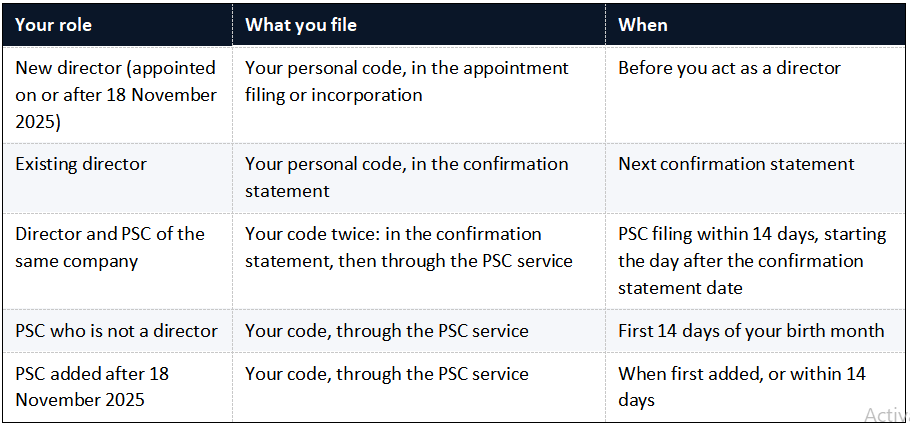 GOV.UK states that 18 November 2025 is not a deadline. It marks the start of the transition year. Your own due date is the confirmation statement date for each company.
Companies House shows each person’s due date on the People tab of the company’s register entry. Check it now rather than in the week your filing falls due.
Can you complete UK director identity verification from abroad?
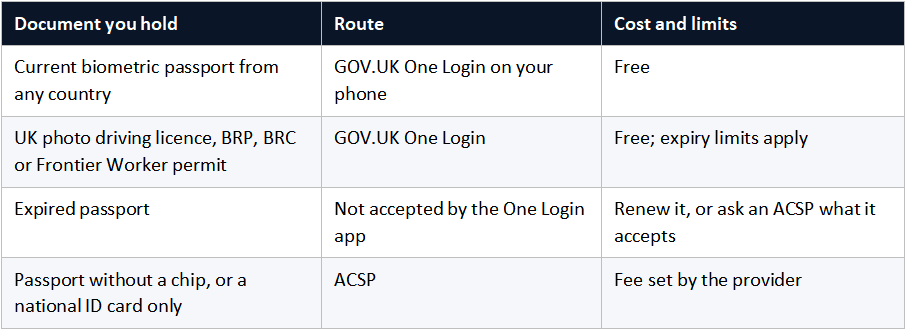
Yes, UK director identity verification from abroad is possible, and neither route needs a UK visit. You can verify free and online with GOV.UK One Login if you hold a biometric passport from any country. Otherwise an Authorised Corporate Service Provider (ACSP) can verify you from any country, though it may charge a fee.
The bank-details route and the Post Office route are offered to people who live in the UK, so most overseas directors will not see them. Your address is not the deciding factor. Your document is.
A director in Dubai, Lagos or Mumbai with a current biometric passport follows the same passport-and-phone route as a director in London. Never post or email identity documents to Companies House. GOV .UK lists One Login and an ACSP as the only permitted routes.
How does GOV.UK One Login work for an overseas director?
GOV.UK One Login checks an overseas director’s identity through a smartphone. You scan the chip in a biometric passport and then your face. You also need your current address and the year you moved in, and the service is free of charge.
Look for the small rectangular symbol on the front cover to confirm your passport is biometric. GOV. UK says you cannot use an expired passport with the One Login app. Do not assume your passport qualifies; check the cover and the expiry date first.
Be wary of any guide that says non-UK passports are rejected. GOV.UK’s own page accepts a biometric passport from any country.
Each person needs a separate login email, because an email address can verify only one identity. Two co-directors cannot share one address.
If the scan fails, start with One Login support. Applicants on Companies House’s own blog describe passport chips that read correctly and then fail at the face check.
When should a non-resident director use an ACSP instead?
Use an ACSP when One Login cannot verify you. That usually means your passport has no chip, you hold only a national ID card, or your passport has expired. An ACSP is an anti-money laundering (AML) supervised professional, such as an accountant, solicitor or formation agent, that Companies House has authorised to verify identities.
ACSPs must register with Companies House and with a UK AML supervisory body. You supply documents from an approved list, and the provider may charge a fee. Companies House says ACSP checks must meet the same assurance level as direct verification.
Choose with care. The ACSP list is opt-in, and Companies House confirms that appearing on it does not oblige a firm to verify you, so you may need to approach several. GOV.UK also warns you not to hand your identity to people you do not trust.
After the check, Companies House emails your personal code to the address the ACSP supplied. Save the code to your own Companies House account so you can retrieve it later.
How does a non-resident verify identity at Companies House in 2026, step by step?
Check your passport, verify through One Login or an ACSP, find your 11-character personal code, then give that code to Companies House for each role. Directors file it in a confirmation statement or appointment. PSCs use a separate online service within a 14-day window.
- Check your passport.Look for the chip symbol and the expiry date. If there is no chip, or it has expired, go to an ACSP.
- Create a GOV.UK One Login.Use an email address that only you control, because it becomes tied to your verified identity.
- Start the Companies House service.Answer the questions about yourself, not your company. Scan the passport chip and your face with your phone.
- Find your personal code.Sign in to Companies House with the same email and open ‘Manage account’. Verifications completed after 8 July 2026 also trigger an email with the code.
- Link the code to each role.Directors include it in the confirmation statement or appointment filing. PSCs use the Provide identity verification details for a PSC
- Share it only with people you trust.You can give the code to an accountant or agent who files for you, but keep it secure.
Companies House says the app route is usually completed in minutes, with an average under 2 minutes 30 seconds for the ID check app. An ACSP route depends on the provider’s own process.
What does the ECCTA ID check mean for a non-resident company director?
The ECCTA made identity verification a personal legal duty, so it follows you rather than the company. A missed check can expose you to prosecution, block your company’s filings and stop you being appointed to new boards. The duty is individual, so a company with three non-resident directors needs three separate verifications.
Responsibility extends to co-directors. In the September 2026 cases, the Insolvency Service said directors must also ensure unverified individuals do not continue acting on the company’s behalf. One convicted director had verified himself and still faced prosecution for failing to stop a co-director.
Does a nominee director change what you must verify?
A nominee director verifies like any other director, and must do so before appointment. That does not remove your own duty. If you hold more than 25% of the shares or voting rights, you remain a PSC and must provide your code in that role.
If you plan to use a nominee director service, confirm the nominee has a personal code before the appointment is filed. Then dirise your own PSC window.
What happens if a non-resident director misses the deadline?
Missing a due date may be a criminal offence, and Companies House can prosecute or impose a financial penalty. GOV.UK warns that you will also be unable to join an existing board as a new director, register a new company or register as an authorised agent. In future, a note will be added against your name on the public register.
Proof box: the first convictions, 16 September 2026
City of London Magistrates’ Court fined three directors £166, £307 and £80, each with £85 costs and a victim surcharge. One had verified himself but was convicted for not stopping a co-director from acting unverified, and all three were also convicted over late confirmation statements.
The sums were modest, but every case ended in a criminal conviction. Those directors lived in the UK, and nothing in the rules gives overseas directors a softer track. The company itself also cannot file a confirmation statement while any director remains unverified.
What should a non-resident director do this week?
Finish verification, save your code and confirm that every co-director has done the same before mid-November 2026. Start with your passport, because its chip and expiry date decide your route. Then work through the six actions below in order, starting today.
- Check your passport for the chip symbol and the expiry date.
- Verify through GOV.UK One Login if the passport qualifies, or ask an ACSP if it does not.
- Save your 11-character personal code to your Companies House account.
- Look up the due date for each company on the People tab of its register entry.
- Confirm every co-director, including any nominee, has verified.
- Give the code to whoever files your confirmation statement.
Companies House identity verification is free online and takes minutes with a biometric passport. Missing the deadline costs a blocked filing or a prosecution.
Frequently asked questions
Do non-resident directors have to verify their identity with Companies House?
Yes. The requirement follows the role, not your address. Anyone setting up, running, owning or controlling a UK company must verify, as the Companies House campaign site states.
Can I verify my identity for Companies House without visiting the UK?
Yes. Use GOV.UK One Login on your phone if you hold a current biometric passport. Otherwise an ACSP can verify you from any country, according to GOV.UK.
Is Companies House identity verification free?
Verifying directly through GOV.UK One Login is free. An ACSP sets its own fee, so ask for the price before you send documents. Companies House does not recommend providers or publish their charges.
Do I verify again for each UK company I direct?
No. You verify once and receive one personal code. You then quote that code for each directorship and PSC role, as GOV.UK explains.
What if my passport has no chip or has expired?
One Login cannot verify you in either case. GOV.UK accepts biometric passports and does not accept expired ones on the app. Ask an ACSP which documents it accepts, or renew the passport first.
Is 18 November 2026 a hard deadline for every director?
Not exactly. Your due date is the company’s next confirmation statement, and the transition year ends in mid-November 2026. Aim to finish well before your filing date, because a company cannot file without every director’s code.
Our team handles company formation, nominee appointment, and legal documentation. No UK visit required. 95+ countries accepted.