

How to Complete a UK Company Formation Application in 5 Minutes
Your part of a UK company formation application takes about five minutes. You upload two documents, choose a company name and pick your business activity.
Getting a non resident application approved first time is where the preparation goes and that’s the part we take on at Activate Global. Our UK company formation service is built for founders who live outside the United Kingdom and we’ve formed 5,000+ companies for clients in 95+ countries.
This guide shows what you do in those five minutes and what we handle: identity checks, a compliant UK address and documents a bank will accept later. It also covers what changed in 2025 and 2026.
Here’s the short answer. You don’t need to live in the UK, visit it or hold a visa to own and run a UK limited company. You do need a UK registered office address, a verified identity and a plan for what happens after incorporation.
In this guide
- What is UK company formation, and can a non-resident do it?
- What do you need before you start the application?
- How do you complete the application in 5 minutes?
- Why does a UK registered office address matter?
- Do you need a UK-resident or nominee director?
- Should you file directly or use a formation agent?
- What happens after your company is incorporated?
- What slows down non-resident applications most often?
- Frequently asked questions
What is UK company formation and can a non resident do it?
UK company formation is the legal process of registering a new company with Companies House, the UK’s official registrar. For most founders, it means a private limited company (Ltd): a separate legal entity whose owners are liable only up to their investment.
Non-residents can form one. GOV. UK confirms that directors don’t have to live in the UK, but the company must have a UK registered office address.
A Ltd company needs at least one director aged 16 or over and at least one shareholder. One person can hold both roles and own 100% of the shares.
Companies House usually registers an online application within 24 hours. The government filing fee is £100, up from £50 under the fee changes that took effect on 1 February 2026.
What do you need before you start the application?
Most delays happen before anything reaches Companies House. Gather these five items first, and the application itself becomes a short job.
- A valid passport for every director and every person with significant control (PSC). A PSC is anyone holding more than 25% of the shares or voting rights.
- Proof of residential address: a utility bill, bank statement or official letter dated within the last three months.
- A company name that isn’t already on the register and follows the naming rules. Keep two back-up options ready.
- Your business activity, expressed as one or more SIC codes that describe how the company will trade.
- A UK registered office address and a registered email address. Both are mandatory at incorporation.
Since 18 November 2025, every new director and PSC must also verify their identity for Companies House. You do this once through GOV.UK One Login and receive a personal code to use on the application. Identity verification for one director is included in our Launch package.
How do you complete the application in 5 minutes?
Your side of the application takes about five minutes. You upload two documents, choose a name and confirm your business activity, and we handle the checks, the filing and the paperwork. Companies House then usually incorporates the company within one to two working days of approved documents.
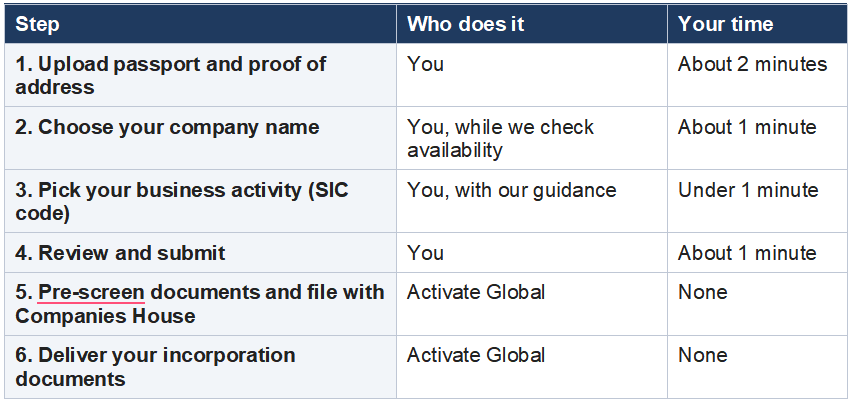
Step 1: Upload your passport and proof of address
You upload both documents through our secure online KYC form. Our team checks them before anything is filed, because a rejected application sends you back to the start.
Step 2: Choose your company name
Enter your preferred name and a back-up. We check it against the Companies House register and the naming rules, so you don’t lose a day to a rejection.
Step 3: Pick your business activity
Choose the SIC codes that describe how you’ll trade, and we’ll help if you’re unsure. The right codes matter later, when banks and payment providers review your account.
Step 4: Review and submit
Check the details and submit. The standard setup is a single director who owns 100% of the shares, which suits most solo founders. You can add shareholders or directors later.
Step 5: We pre-screen and file with Companies House
Once each director and PSC has shared their identity verification code, we file the incorporation. The filing includes your registered office, share structure and Memorandum and Articles of Association.
Step 6: Receive your incorporation documents
You get a digital Certificate of Incorporation, your Memorandum and Articles and your share certificates. The certificate confirms your company number and date of formation, and it’s the first document a bank will ask for.
Prefer to talk it through first? Book a free consultation on WhatsApp, live chat or phone, and we’ll confirm the right structure before you start.
| Activate Global in numbers
5,000+ companies formed for founders in 95+ countries, with a 100% remote process. If we can’t form your company, we refund our fee in full. |
Why does a UK registered office address matter?
Your registered office is the company’s official legal address. Companies House, HMRC and the courts send formal post there, and it appears on the public register. Without a valid one, Companies House won’t register your company.
The rules tightened under the Economic Crime and Corporate Transparency Act 2023. The address must be a physical UK address in the same country your company is registered in. It must also be “appropriate”: post must reach someone acting for the company, and senders must be able to get proof of delivery.
A PO Box no longer qualifies, and neither does an overseas address. A company that can’t keep a compliant address can be struck off the register.
Our UK registered office address service uses Tower Bridge Business Centre, 46-48 East Smithfield, London E1W 1AW. We receive your official mail, scan it to PDF and email it to you, usually within 24 hours. Add a director service address, and your home address stays off the public register too.
Do you need a UK-resident or nominee director?
No. UK law doesn’t require a UK-resident director for a private limited company. Some UK banks and payment providers prefer one when they assess a new business account, which is why some non-resident founders appoint a nominee director.
A nominee director is a UK-resident individual appointed in an administrative role. Through our nominee director service, the nominee appears on the Companies House register while you keep control through a Power of Attorney and a signed indemnity agreement.
Know the limits before you sign. A nominee can’t access your bank account, sign contracts without your written instruction or hold shares in your company.
A nominee also can’t hide who owns the company. You still appear on the register as a person with significant control, and the arrangement can’t be used to conceal ownership from HMRC.
Should you file directly or use a formation agent?
If you live in the UK and have a simple single owner setup, filing directly with Companies House is cheap and quick. Non-residents usually find the address rules, identity checks and bank onboarding harder to handle alone.
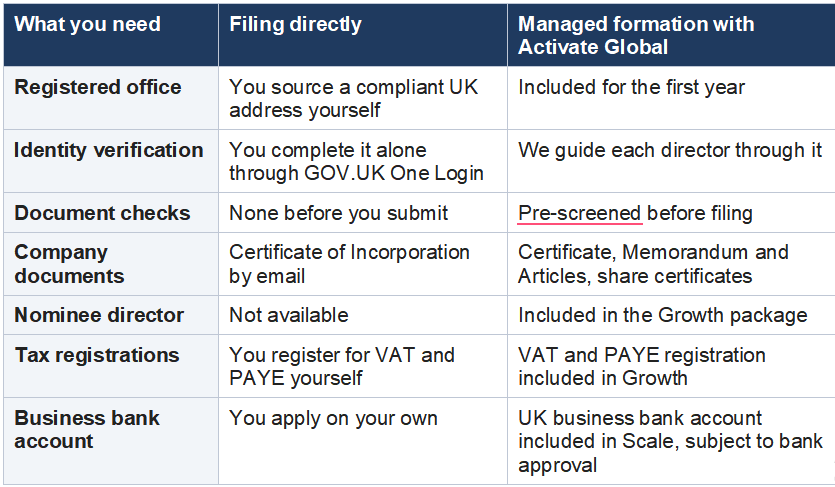
Our packages are tiered the same way. Launch covers formation, the registered address and your documents. Growth adds a nominee director, VAT and PAYE registration and the first confirmation statement, while Scale adds a UK business bank account and ongoing compliance management.
What happens after your company is incorporated?
Incorporation starts your obligations. In the first few weeks, HMRC sends your tax details, and within the first year you’ll file with both Companies House and HMRC.
- Unique Taxpayer Reference (UTR): HMRC posts your 10-digit UTR to the registered office. If it hasn’t arrived within 15 working days, you can request it online.
- Corporation Tax: Add Corporation Tax services to your business tax account once you start doing business. If you live abroad, the activation code can take up to 21 days to arrive.
- VAT: Registration is compulsory once taxable turnover passes £90,000 in 12 months, or you expect it to within 30 days. You can also register voluntarily below that figure.
- PAYE: Register as an employer before your first payday, including when you’re the only director on the payroll.
- Annual filings: A confirmation statement at least once every 12 months, annual accounts with Companies House and a Company Tax Return with HMRC.
For a business bank account, your Certificate of Incorporation, UK address and clear SIC codes do most of the work. Our Scale package includes a UK business bank account, and we support you through the bank’s KYC checks.
What slows down non-resident applications most often?
Four problems cause most of the delays we see. Each is easy to avoid if you know about it before you apply.
- Name clashes. Companies House rejects a name that’s the same as, or too like, an existing one. Check the register and keep back-ups ready.
- Address proof that doesn’t match. Your bill or statement must be in your own name and under three months old. Small spelling differences from your passport can trigger extra checks.
- A non-compliant registered office. Home addresses abroad and PO Boxes don’t qualify. Use a physical UK address that can receive and sign for post.
- Vague SIC codes. A gap between your SIC code and how you trade raises questions when you open a bank or payment account. Pick codes that describe your real activity.
Frequently asked questions
Can I form a UK company for non resident without visiting the UK?
Yes. The whole process, from identity verification to incorporation, happens online. You don’t need a visa or UK residency to own or direct a UK limited company.
Does a 5 minute application mean my company is formed in 5 minutes?
No. Five minutes is your part: documents, name and activity. Companies House usually registers online applications within 24 hours, and our clients typically receive their incorporation documents within one to two working days of approved KYC.
Can I be the only director and shareholder?
Yes. A private limited company needs one director aged 16 or over and one shareholder. The same person can fill both roles and hold 100% of the shares.
Do I need a UK bank account before I apply?
No. You open a business account after incorporation, using your Certificate of Incorporation. Our Scale package includes a UK business bank account, subject to the bank’s approval.
Is a nominee director legal in the UK?
Yes, when it’s used for legitimate administrative purposes. The beneficial owner still appears on the Companies House register as a person with significant control.
Will my home address appear on the public register?
Your registered office and director service address are public. Using our registered office and service address keeps your home address off the register.
Ready to start your UK company?
Your part takes about five minutes: upload your passport and proof of address, then choose a name and activity. We pre-screen your documents, file with Companies House and deliver your incorporation documents, usually within one to two working days.
Our team handles company formation, nominee appointment, and legal documentation. No UK visit required. 95+ countries accepted.