
UK Tax and Companies House Deadlines 2027 for Non-Residents
Late accounts cost a UK company between £150 and £1,500, and the penalty doubles if you’re late two years running. HMRC adds its own penalties on top. Neither authority makes an exception for directors who live abroad.
We’ve handled UK company formation for 5,000+ companies across 95+ countries. Forming the company takes one to two working days. Keeping it in good standing takes a calendar.
This guide sets out every UK tax and Companies House deadline for 2027, the penalties for missing them, and the extra planning overseas directors need. We’ve checked the dates against GOV.UK as at October 2026.
In this guide
- What are the UK tax and Companies House deadlines for 2027?
- What changes for UK company directors in 2027?
- How do you work out your own company’s deadlines?
- Which deadlines repeat every month or quarter?
- What does the 2027 deadline calendar look like?
- What do overseas directors need to know about UK deadlines?
- What does a missed deadline cost?
- How does Activate Global handle UK compliance for overseas directors?
- Frequently asked questions about UK deadlines in 2027
What are the UK tax and Companies House deadlines for 2027?
A UK compliance deadline is a fixed date by which a company must file a document or pay tax to Companies House or HMRC. Missing one triggers an automatic penalty. Every UK limited company faces the same core set: annual accounts, a confirmation statement, a Corporation Tax return and payment, plus VAT and PAYE returns once registered.
Your company’s accounting reference date drives most of these dates. It’s the last day of your financial year. Once you know it, nearly every deadline follows by simple counting.
What changes for UK company directors in 2027?
Four changes matter most. Director identity verification is now a legal requirement, with a 12-month transition that began on 18 November 2025. Making Tax Digital for Income Tax reaches incomes above £30,000 from April 2027.
The online confirmation statement fee is £50. Companies House’s accounts reforms have moved to 1 April 2028.
Director identity verification
Every director and person with significant control (PSC) must verify their identity with Companies House. Existing directors give their personal code with the company’s next confirmation statement. Missing it is an offence, and it can stop you filing anything for the company.
Overseas directors can verify online through GOV.UK One Login using a biometric passport from any country. An Authorised Corporate Service Provider can also verify on your behalf. Do this before your confirmation statement is due, not on the filing day.
Making Tax Digital for Income Tax
This regime applies to individuals, not limited companies. It matters if you also have UK self-employment or property income above £30,000 from 6 April 2027. The threshold was £50,000 from April 2026 and falls to £20,000 in April 2028.
Your first quarterly update is due on 7 August 2027. HMRC’s guidance explains the software you’ll need.
Companies House accounts reforms
Software only iXBRL filing, profit and loss accounts for smaller entities, and the end of abridged accounts now take effect on 1 April 2028. That’s a year later than first planned. You don’t need to change anything in 2027, but if your accounts are prepared by hand today, plan the move this year.
How do you work out your own company’s deadlines?
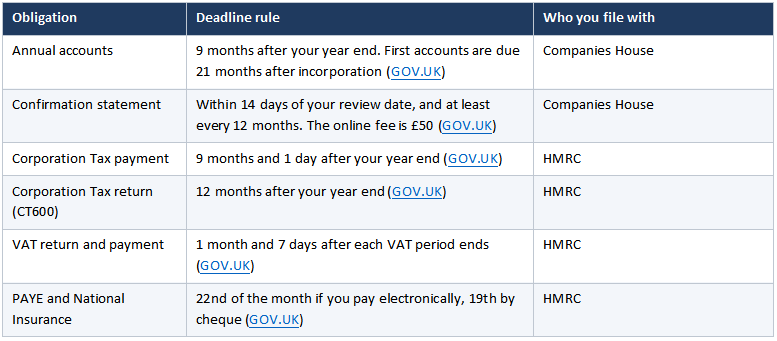
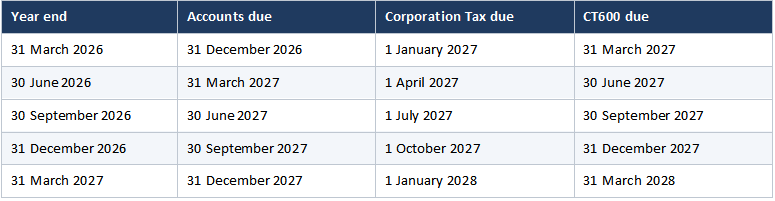
Start with your accounting reference date. Annual accounts are due nine months after it, Corporation Tax nine months and one day after it, and the CT600 return twelve months after it. Your first accounts are the exception: they’re due 21 months after you incorporated.
Your confirmation statement runs on a separate clock. File it within 14 days of your review date, and at least once every 12 months. The review date is usually the anniversary of incorporation, and Companies House sets out the process.
Filing deadlines don’t move for weekends or bank holidays. If a payment date falls on a weekend, choose a method that clears in time and pay early.
Which deadlines repeat every month or quarter?
VAT returns and payments are due one calendar month and 7 days after each VAT period ends. PAYE and National Insurance are due by the 22nd of each month if you pay electronically, or the 19th by cheque. Full Payment Submissions go to HMRC on or before each payday.
Your VAT dates depend on your quarter pattern. Find your quarter-end months below.

The £90,000 registration threshold applies to UK established businesses. A business not established in the UK must register for VAT from its first taxable supply here. If your company sits between those two positions, we’ll confirm which applies before you register.
What does the 2027 deadline calendar look like?
The calendar below lists the dates that matter for a UK limited company with overseas directors, in order. Company dates depend on your year end, so we’ve used 31 March, 30 June, 30 September and 31 December 2026 as examples. Personal dates apply only if a director or shareholder files a UK Self Assessment return.
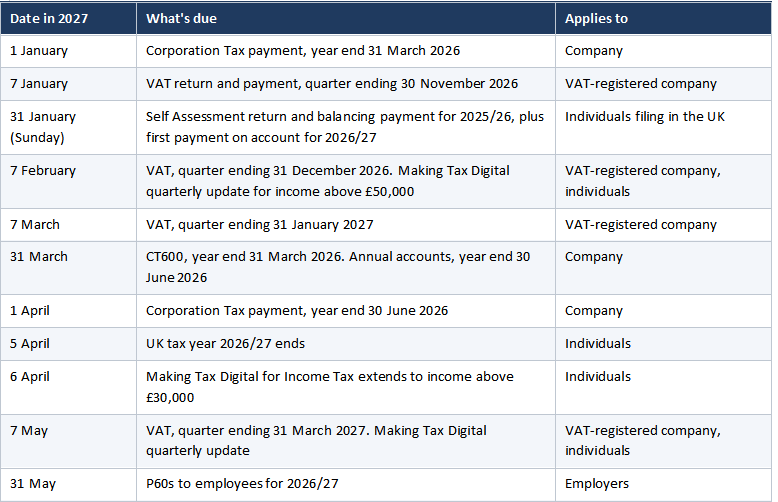
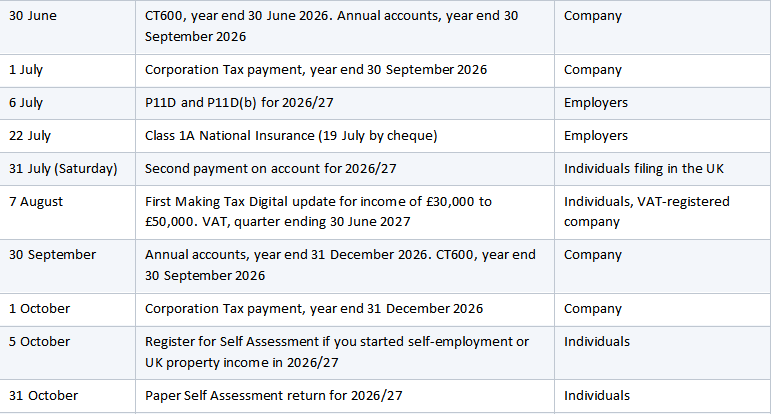
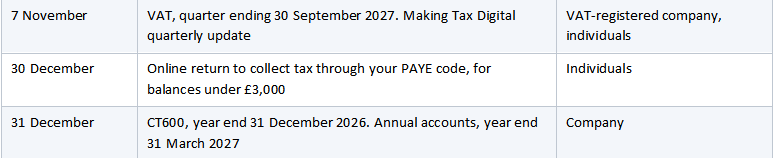
Your confirmation statement isn’t in the table because its date is personal to your company. Check the review date on the public register and file within 14 days of it.
Directors must approve the accounts before they’re filed, so allow time for sign-off across time zones. We suggest diarying each date four weeks ahead.
What do overseas directors need to know about UK deadlines?
A company incorporated in the UK is UK tax resident wherever its directors live, so it files UK accounts and pays UK Corporation Tax on its profits. Distance doesn’t change a single date. It changes how you receive notices, verify identity and pay HMRC.
Official letters go to your registered office address. We include one in all three of our formation packages, and our UK registered office address service explains how post reaches you.
Payment deadlines assume you can move money on time. A UK business account makes that simple, and we help non-residents with UK banking as part of formation.
Identity checks, covered above, apply to every overseas director and PSC. Plan them early. A director who can’t pass the online check stops the whole company filing.
What does a missed deadline cost?
Penalties are automatic. Companies House charges £150 to £1,500 for late accounts, and HMRC charges £200 for a Corporation Tax return filed even one day late. Late payment of tax adds interest on top.
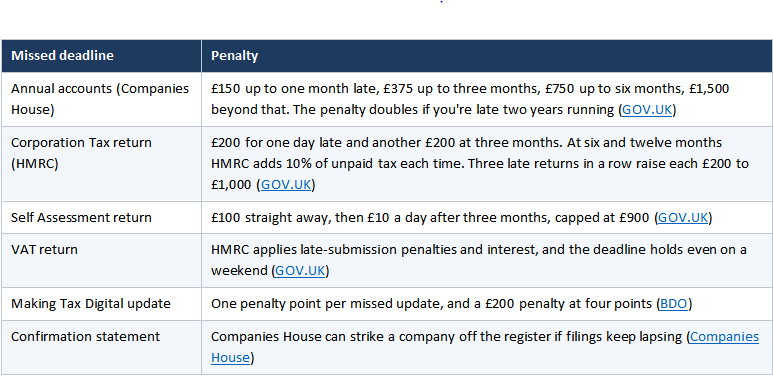
That’s why we back our accounting work with a zero-penalty promise. If a penalty arises from our own error or delay, we cover it or refund that service.
How does Activate Global handle UK compliance for overseas directors?
We run the compliance calendar for you. Each client has a dedicated accountant, and our UK accounting services cover year-end accounts with iXBRL filing, the CT600, MTD-compliant VAT returns, Self Assessment and confirmation statements. We’re an HMRC registered agent, and we reply to every enquiry form within two hours.
No company yet? Our UK company formation for non-residents packages start at £349 and include the Companies House fee and a registered office address for one year. Growth adds your first confirmation statement, VAT and PAYE registration and a dedicated account manager.
Already hold a UK company? Tell us your year end and where your directors live. We’ll map your 2027 deadlines and quote for the work.
Frequently asked questions about UK deadlines in 2027
When is the Self Assessment deadline in 2027?
Online returns and the balancing payment for 2025/26 are due by 31 January 2027. Paper returns for 2026/27 are due by 31 October 2027, and online returns for 2026/27 are due by 31 January 2028. Self Assessment applies to individuals, not to your limited company.
When is Corporation Tax due?
Payment is due 9 months and 1 day after your accounting period ends. The CT600 return is due 12 months after it. A company with a 31 December 2026 year end pays by 1 October 2027 and files by 31 December 2027.
When are annual accounts due at Companies House?
Nine months after your year end. Your first accounts are due 21 months after the date you incorporated. Late filing carries a penalty from £150 to £1,500.
Do deadlines move for weekends or bank holidays?
No. Filing deadlines stay fixed, and VAT deadlines apply even on a weekend or bank holiday. Make payments early enough to clear before the date.
Do dormant companies have deadlines?
Yes, a dormant company still files accounts and a confirmation statement with Companies House. It needs a Corporation Tax return only if HMRC issues a notice to deliver one, and GOV.UK explains what counts as dormant.
Do I need a UK accountant if all my directors live abroad?
No law requires you to appoint one. But your accounts must meet UK rules, and HMRC expects them in iXBRL format with the CT600. Most overseas directors use a UK-based accountant for that reason.
Can Activate Global take over my accounting if I formed my company elsewhere?
Yes. Send us your year end, your last filed accounts and your registered office details. We’ll confirm the deadlines ahead and quote through our UK accounting services.
Ready to put your 2027 deadlines in order?
Three steps to take this month: confirm your year end and review date on the public register. Then verify the identity of every director and PSC. Finally, check whether you’re VAT registered or exposed to Making Tax Digital.
Every 2027 deadline follows from one date, your year end, plus the 12 month confirmation statement cycle. Tell us yours and we’ll build your calendar.
Our team handles company formation, nominee appointment, and legal documentation. No UK visit required. 95+ countries accepted.