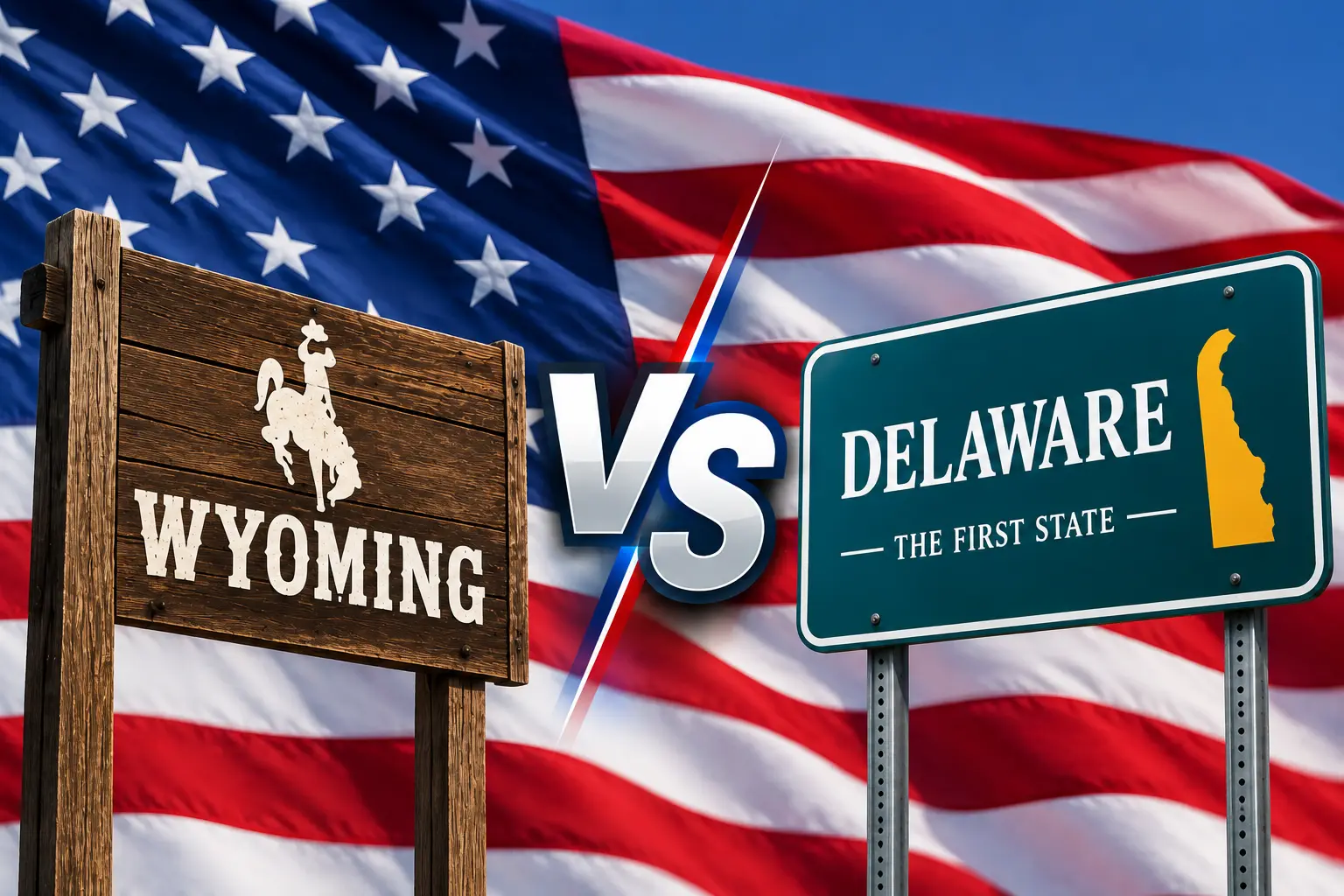
Wyoming vs Delaware LLC for Non-Residents: Which Is Better in 2026?
Wyoming and Delaware are both legitimate choices for a U.S. LLC owned by a non-resident, but they solve different problems. Wyoming is often considered when the priority is a straightforward LLC structure with comparatively low state-level maintenance costs. Delaware is often considered when the business expects sophisticated legal structuring, outside investment, or a strong connection to Delaware’s established business-law ecosystem. Neither state automatically eliminates U.S. federal tax or filing obligations, and forming an US LLC company in one state does not prevent another state from imposing registration or tax obligations when the business actually operates there.
For a non-resident founder with no U.S. office, employees or other operating footprint, the choice should start with the business model rather than the state’s marketing reputation. A solo consultant, online agency, ecommerce seller and venture-backed technology company can have very different reasons for choosing the same state.
A Quick Comparison Between Wyoming vs Delaware LLC
Factor |
Wyoming LLC |
Delaware LLC |
| State formation filing fee | $100 for a standard LLC filing | State fee varies by filing method and service; verify the current fee before filing |
| Recurring state requirement | Annual report and annual fee | $400 annual LLC tax; no annual report for Delaware LLCs |
| Annual due date | Based on the anniversary month of formation | June 1 |
| State income tax | Wyoming has no individual or corporate state income tax | Delaware has state-level taxes that can apply depending on the business and income |
| Business-law ecosystem | Strong LLC-focused statutes and established asset-protection reputation | Deep corporate and commercial-law ecosystem; Delaware Court of Chancery is a major business-law forum |
| Registered agent | Required | Required; Delaware requires a physical Delaware registered-agent address |
| Privacy | Wyoming filings can offer limited public disclosure, but privacy is not anonymity | Public records and registered-agent requirements still apply; privacy depends on the filing and ownership structure |
| Typical fit | Owner-operated and closely held businesses where simple LLC administration matters | Businesses that may need Delaware’s established legal ecosystem or more complex structuring |
The First Question: Where Will the Business Actually Operate?
This is the part many state-comparison articles skip. The state printed on your Certificate of Organization is not the same thing as the state where your business is legally operating.
If a Wyoming LLC has employees, an office, inventory, property, or other activities that require registration in another state, the company may need to qualify there as a foreign LLC and comply with that state’s tax, licensing and reporting rules. The same principle applies to a Delaware LLC. Choosing Delaware or Wyoming does not create a nationwide exemption from state compliance.
For a non-resident, this distinction matters even more. If you live outside the United States and run the business from abroad, your U.S. state-formation decision is only one part of the structure. You also need to consider U.S. federal tax classification, information returns, your country of residence, treaty rules where relevant, sales-tax exposure, payment processing and where business activities actually take place.
What is Wyoming LLC for Non-Residents?
Wyoming is commonly considered by foreign founders who want a U.S. LLC without building a more elaborate corporate structure. The state provides an established LLC framework and requires an annual report. The Wyoming Secretary of State states that the annual report is due based on the entity’s anniversary month, and the fee is generally at least $60, subject to the state’s asset-based calculation rules.
For a founder who expects to remain the sole owner, operate remotely and keep the business relatively simple, Wyoming can be a practical state to investigate. That does not mean every non-resident should form there. Banking, tax, licensing, customer requirements and future financing can outweigh the difference in state fees.
What is Delaware LLC for Non-Residents?
Delaware is widely used for U.S. business entities and has a mature body of business law. Its Court of Chancery is specifically focused on business disputes and is a major reason Delaware has a strong reputation in corporate and commercial matters.
For Delaware LLCs, the state currently requires a $400 annual tax, due by June 1, and does not require an annual report for LLCs. That recurring state cost is materially higher than Wyoming’s minimum annual report fee, so the reason for choosing Delaware should generally be tied to the business’s needs rather than the idea that Delaware is automatically a better state.
Delaware can become more relevant when a business expects sophisticated ownership arrangements, outside investors, institutional counterparties, or legal work that benefits from Delaware’s established business-law environment. However, an LLC is not the same legal vehicle as a Delaware corporation, and founders planning a venture-capital-backed company should compare the LLC structure itself with the possibility of forming a corporation.
What is the Cost Difference Between Wyoming vs Delaware LLC Company Formation?
At the state level, Wyoming is generally less expensive to maintain for a standard LLC. Wyoming’s Secretary of State lists a $100 formation filing fee and an annual report license tax of $60 or $0.0002 of Wyoming-located and employed assets, whichever is greater. Delaware LLCs pay a $400 annual tax and do not file an annual report.
These figures are state charges only. A non-resident should also budget for a registered agent, business address or mail service if needed, tax preparation, federal information returns, bookkeeping, banking or payment services, licenses, and any foreign qualification in states where the business actually operates.
Wyoming vs Delaware LLC Taxes: What Non-Residents Need to Understand?
State formation and federal taxation are separate questions. Saying that Wyoming has no state individual or corporate income tax does not mean a foreign-owned Wyoming LLC has no U.S. tax or reporting obligations.
The IRS determines federal tax treatment based on the entity’s classification, ownership and activities. A non-resident’s U.S. tax position can also depend on whether the business is engaged in a U.S. trade or business and whether income is effectively connected with that business.
A foreign-owned single-member U.S. disregarded entity can have information-reporting obligations even where the owner does not owe U.S. federal income tax on the business’s profits. For example, the IRS instructions for Form 5472 explain that a foreign-owned U.S. disregarded entity is treated as a reporting corporation for certain information-reporting rules and may need to file a pro forma Form 1120 with Form 5472 when reportable transactions exist.
This is one of the most important points for non-resident founders: do not choose Wyoming because someone promised ‘zero tax,’ and do not choose Delaware because someone implied that its legal reputation changes your federal tax position. The tax analysis needs to be done from the actual ownership, activity and income facts.
Do Non-Residents Need a U.S. LLC in Delaware?
No. There is no general rule requiring a foreign founder to form an LLC in Delaware simply because the owner is not a U.S. resident.
The relevant question is what the company is trying to accomplish. If the business is a closely held online company operated from outside the United States, a simpler LLC state may be sufficient. If the company expects institutional investment or complex legal structuring, Delaware may deserve closer consideration.
Wyoming vs Delaware for Different Business Models
Business situation |
What to examine |
| Solo consultant or agency | Compare Wyoming’s lower recurring state cost and simple LLC administration with the founder’s actual operating and tax position. |
| SaaS or software business | Consider customer expectations, payment providers, intellectual property ownership, future fundraising and where the business operates. Do not select a state solely for tax slogans. |
| E-commerce business | Inventory location, fulfillment, sales tax and economic nexus can matter more than the formation state. |
| Amazon or marketplace seller | Check marketplace onboarding, banking requirements, tax registrations and where inventory or operations create obligations. |
| VC-backed startup | Consider whether an LLC is the right long-term entity at all. Investor expectations and future financing can make a Delaware corporation a separate option worth evaluating. |
| Holding or investment structure | The ownership chain, tax classification and asset type can be more important than the state comparison itself. |
Bank accounts and Payment Processors
Neither Wyoming nor Delaware guarantees approval for a U.S. bank account, fintech account, Stripe account, PayPal account or another payment service. Providers make their own risk and compliance decisions and may review the owner, business model, website, source of funds, expected transaction activity, customer geography and identification documents.
For a non-resident, the quality and consistency of the business documentation can matter as much as the state of formation. A clear website, business description, ownership documents, EIN, identity documents, proof of address and coherent explanation of the company’s activities can help a provider understand the business, but approval is never guaranteed.
Privacy: Wyoming is not Anonymous
Wyoming is often marketed around privacy, but privacy should not be confused with anonymity. A registered agent, state filings, banks, payment providers and tax authorities can require identifying information. A business owner should assume that lawful regulators and financial institutions can obtain information required under applicable rules.
Also note that the federal beneficial-ownership reporting landscape changed significantly in 2025. FinCEN states that entities created in the United States are currently exempt from CTA BOI reporting, while the remaining reporting-company definition focuses on certain entities formed under foreign law and registered to do business in the United States. This is separate from state formation records and financial-institution KYC requirements.
Registered Agent Requirements
Both states require an LLC to maintain a registered agent. Delaware specifically states that an entity must maintain a registered office and registered agent in Delaware, and the registered agent must have a physical street address in the state.
For a non-resident, this usually means using a professional registered-agent service rather than trying to provide a personal U.S. address. The registered agent receives official notices and service of process; it is not automatically a substitute for a business office, mailing address, or operating location.
Wyoming vs Delaware: a Practical Decision Framework
- Start with where the business actually operates, not where an online formation service says it is cheapest.
- Identify whether the business will remain closely held or is likely to seek institutional investment.
- Separate state-level fees from federal tax and information-reporting obligations.
- Map inventory, employees, contractors, offices and other activities that could create obligations in additional states.
- Check banking and payment-provider requirements before assuming the formation state will solve onboarding.
- Estimate the full annual compliance cost, including registered agent, tax preparation and required filings.
- If the business is likely to become investor-backed, compare an LLC with a corporation before forming the entity.
Common Mistakes Non-Residents Make
| Mistake | Why it matters |
| Choosing Wyoming solely because it is advertised as a ‘no-tax state’ | State income-tax treatment does not eliminate federal tax analysis, information returns or obligations created by operating in another state. |
| Assuming Delaware automatically makes banking easier | Banks and fintechs assess the business and owner independently; formation state is only one part of the review. |
| Ignoring foreign qualification | A company can be formed in one state and still need registration in another state where it actually does business. |
| Treating an LLC as a tax status | An LLC is a legal entity type. Federal tax classification is a separate issue. |
| Forgetting foreign-owner reporting | A foreign-owned U.S. disregarded entity can have IRS information-reporting requirements even when the owner’s U.S. income-tax result is not what they expected. |
| Assuming privacy means anonymity | State filings, financial institutions and government agencies can require identifying information. |
Frequently Asked Questions
Is Wyoming or Delaware better for a non-resident LLC?
There is no universal answer. Wyoming can make sense for a closely held business where lower recurring state-level costs and a straightforward LLC structure matter. Delaware may make more sense where the business expects sophisticated legal structuring, investors or other reasons to use Delaware’s established business-law ecosystem.
Is Wyoming cheaper than Delaware for an LLC?
Generally, yes at the state-maintenance level. Wyoming’s annual report fee is generally at least $60, while Delaware LLCs currently pay a $400 annual tax. Registered-agent and other professional costs are separate.
Does a Wyoming LLC mean I pay no U.S. tax?
No. Wyoming’s state tax environment does not determine federal tax treatment. A non-resident’s U.S. tax position depends on the entity’s classification, activities, income and other facts.
Do Delaware LLCs have to file an annual report?
Delaware LLCs do not file an annual report with the Division of Corporations, but they must pay the state’s annual LLC tax by June 1.
Can a non-resident form a Wyoming LLC?
A non-resident can generally form a Wyoming LLC, subject to the state’s filing requirements and any applicable federal, banking, tax and immigration considerations.
Can a non-resident form a Delaware LLC?
Yes. Non-U.S. residents can form Delaware LLCs, subject to state formation requirements and separate federal, tax, banking and compliance obligations.
Which is better for a SaaS startup: Wyoming or Delaware?
The answer depends on the startup’s ownership, funding plans, operations and long-term structure. If institutional investment is likely, the founders should also compare an LLC with a Delaware corporation rather than treating the decision as only a Wyoming-versus-Delaware LLC question.
Does the state of formation determine where my business pays tax?
Not by itself. A business may have tax or registration obligations in states where it has a sufficient operating presence or other nexus. Federal tax rules are separate from state formation.
Do foreign-owned U.S. LLCs have IRS filing requirements?
They can. A foreign-owned U.S. single-member disregarded entity may have information-reporting requirements, including Form 5472 with a pro forma Form 1120 when the applicable reporting rules are triggered.
Does Wyoming or Delaware guarantee a U.S. bank account?
No. Banks and fintech providers make their own onboarding decisions based on the owner, business, documentation, expected activity and compliance requirements.
Our team handles company formation, nominee appointment, and legal documentation. No UK visit required. 95+ countries accepted.